SLS 3D Printing Service

Fast-turnaround prototyping
Industrial-grade 3D printing
Precision parts on demand



Our SLS 3D Printing Service
Production Capacity

345mm*345mm*420mm

1-3 business days

±0.2-0.3mm/100mm

25-100 um
SLS 3D Printing Overview
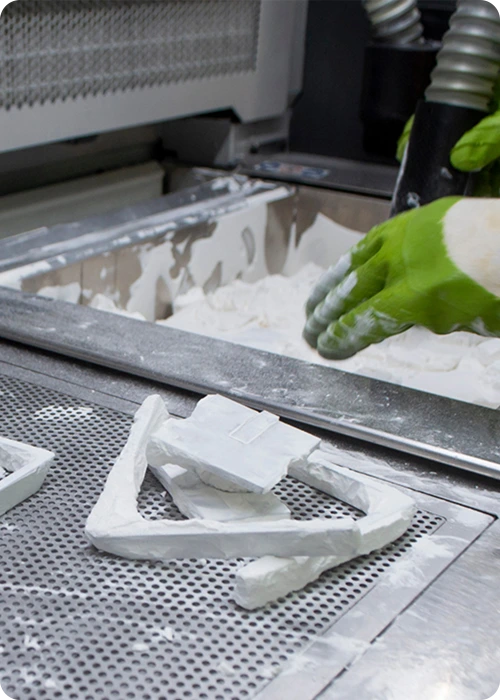
Selective Laser Sintering (SLS) is a versatile industrial 3D printing technology that
produces precise, high-performance prototypes and end-use parts, with production times as
fast as just one day. By utilizing a range of materials, including nylon-based resins and
thermoplastic polyurethane (TPU), SLS creates robust, durable parts that excel in heat
resistance, chemical stability, flexibility, and dimensional accuracy.
Unlike other 3D printing methods, SLS doesn’t require support structures, allowing for
more efficient builds where multiple parts can be nested together in a single print. This
makes it an economical choice for producing larger quantities of functional components or
complex geometries.
Advantages of HLH SLS Printing

Complex Geometries
SLS can print complex and intricate parts with fine details. That makes it well-suited for producing functional prototypes and end-use parts with unique shapes.

Rapid mass production of parts
Multiple parts can be produced at the same time in a single build. The laser used during SLS has a quick scanning speed. That means high throughput at a low cost per part.

Low Cost Per Part
Leftover powder can be reused and support structures are not needed. Also, post-processing is less labor intensive than with other 3D printing methods. That makes SLS parts very affordable.

Design Flexibility
This industrial 3D printing process enables you to build parts with complex geometries, moving parts and pieces with interior components. That’s because it doesn’t require support structures.

Superior Mechanical Properties
Due to the strong bonding between the layers, parts produced using SLS often exhibit excellent isotropic properties. This means they have better tensile strength and hardness.

Colorability
SLS parts have porous surfaces. That means they can be enhanced using a variety of colors and dyes.
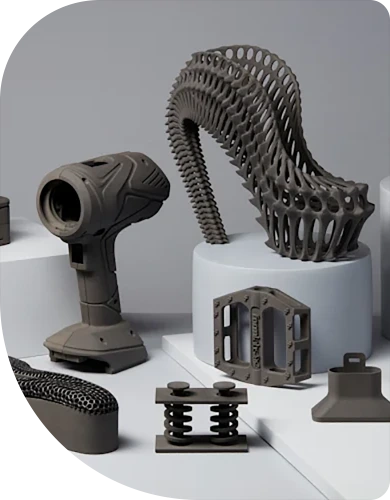
Applications Showcase the Versatility of SLS
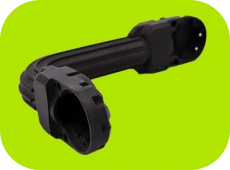
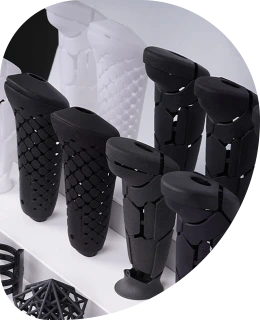

Medical
Custom-fit prosthetics, orthotic, and surgical guides are common uses of SLS because of the precision it makes possible and the biocompatibility of SLS materials.

Aerospace
Lightweight components that can withstand high stress and temperatures, such as ducting, brackets and housings.

Consumer Goods
Products like custom eyewear, intricate jewelry designs, footwear and sporting equipment benefit from the ability to create complex and durable parts.

Automotive
Used for prototyping and creating functional parts, including snap-fit and living hinge components.
SLS Material Options
TPU (Thermoplastic Polyurethane)
SLS technology allows you to 3D print TPU, a rubber-like material known for its exceptional elasticity, flexibility, and smooth texture. Despite its soft touch, TPU is highly durable and strong, making it ideal for applications in automotive, medical, and consumer goods industries.
PA12+GF (Glass-Filled Nylon)
When enhanced with glass fibers (GF), SLS-printed PA12 becomes a strong alternative to metal. This material offers the same benefits as standard polyamide but with significantly higher thermal resistance (up to 110°C), increased strength, and enhanced rigidity. PA12+GF is perfect for high-performance applications where toughness, temperature resistance, or wear resistance are critical.
PA12 (Nylon)
SLS technology allows you to 3D print TPU, a rubber-like material known for its exceptional elasticity, flexibility, and smooth texture. Despite its soft touch, TPU is highly durable and strong, making it ideal for applications in automotive, medical, and consumer goods industries.
SLS 3D printing post-processing
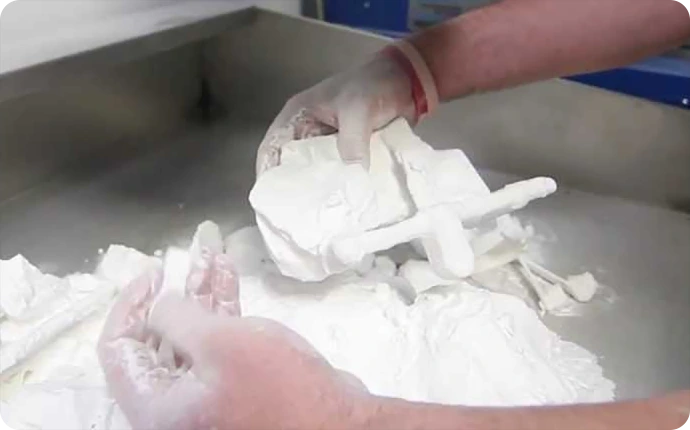
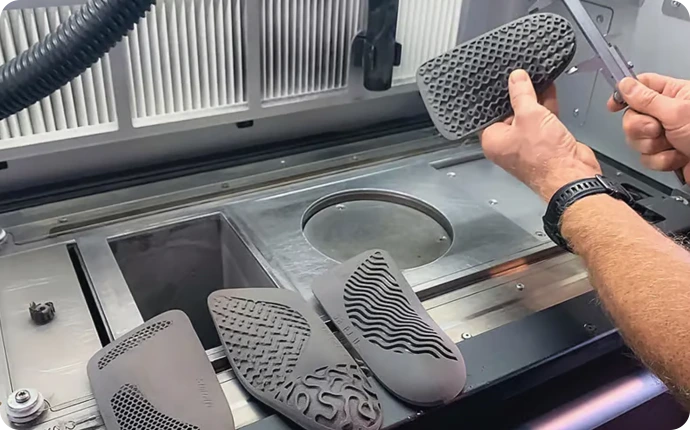
Dyeing
Reaches all surfaces of a part, including the most inaccessible recesses, resulting in a very uniform finish.
Painting
A well-known way to add colors and hide print lines.
Polishing
It is commonly used to improve the appearance of a part, prevent contamination, eliminate oxidation, create a smooth surface, or protect against corrosion.
Spray Painting
A quick way to color parts, reaching areas that cannot be reached with a brush.
Request A Quote
Ready for Pricing? Let’s Get Started.
Please place file(s) for transfer in the same folder and ZIP or RAR before attaching.
Video display

What it’s like to work with HLH – in our customers’ words

"It is a pleasure to work with a company whose personnel are willing and able to think out of their box. With your commitment to staying on the cutting edge of technology, you supply tooling to us that is right on time and works first shot."


"Not many other manufacturing facilities would prioritize a job with a volume this low. They treated us as if we were a long-time customer bringing in high-volume business."

“HLH has been a strong partner on our EV programs. They helped us optimize a few key mponents for weight and manufacturability, and they consistently hit the tolerances we need. Their fast turnaround times have kept our development cycles moving, which is critical in EV work.”
Recent Articles/Blog
3D Printing vs, CNC vs. Vacuum Casting
This article compares and contrasts three common manufacturing methods: 3D printing, CNC machining, and vacuum casting.
How Much Does 3D Printing Cost?
Learn about 3D printing costs, including in-house vs. outsourcing options, with a free cost calculator and saving tips.
CNC Machining Price Guide: Breakdown & Price Comparison
Break down CNC machining prices, learn cost-saving strategies, and compare several major CNC service providers.