SLA 3D Printing Service

Fast-turnaround prototyping
Industrial-grade 3D printing
Precision parts on demand



Our SLA 3D Printing Service
Production Capacity

1700mm*800mm*600mm

1-3 business days

±0.1-0.3mm/100mm

25-100 um
SLA 3D Printing Overview
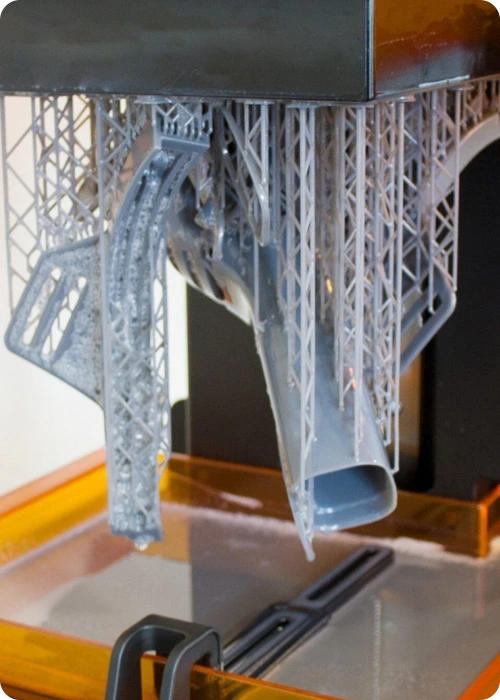
As one of the methods of 3D printing, SLA 3D printing is a form of additive manufacturing
that employs a laser to solidify liquid resin, building up objects one thin layer at a
time. This process allows for the creation of parts with exceptional detail and accuracy.
By precisely controlling the laser, SLA can produce highly intricate designs with smooth
finishes. It is known for its ability to produce smooth surface finishes and intricate
geometries, making it ideal for applications requiring fine detail and high accuracy. It
is commonly used in industries such as aerospace, automotive, and healthcare for rapid
prototyping, functional parts, and small-batch production. The process is valued for its
speed, precision, and versatility in producing complex designs.
Advantages of HLH SLA Printing

High-Quality Surface Finish
The excellent surface finish and dimensional accuracy of SLA prototype parts make them ideal for testing for fit and finish.

Clear Parts
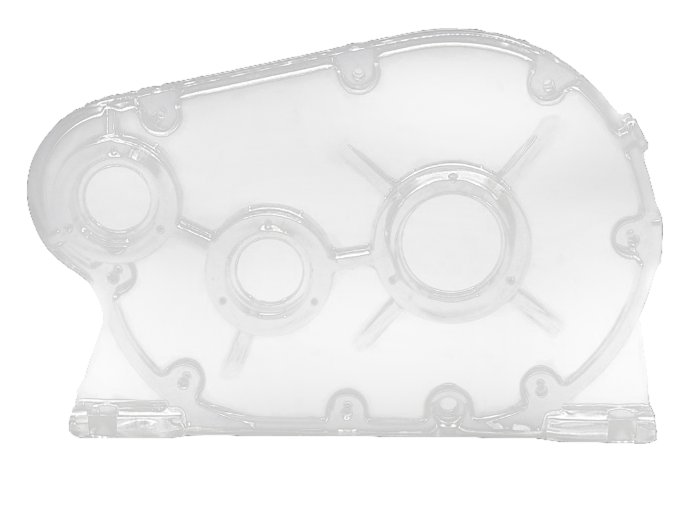
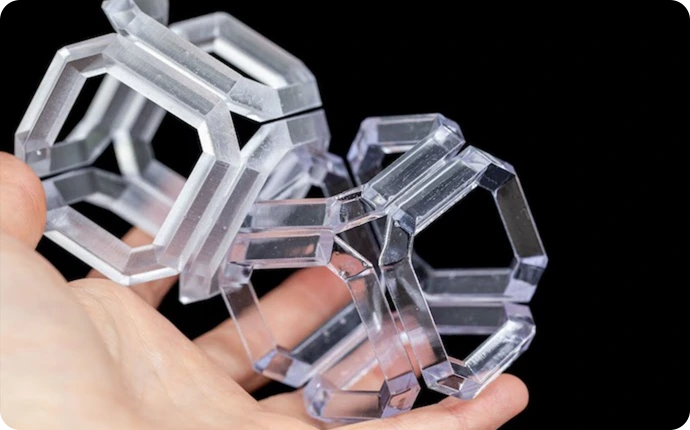
HLH’s SLA printing service can print parts using a clear resin which can be sanded to an optically clear finish that is almost glass-like in appearance.

Print Complex Shapes
Thanks to its fine resolution (hundreds of microns), stereolithography 3D printing can be used to print thin walls, sharp corners, small holes and complex shapes.

Tolerances
SLA offers some of the tightest dimensional tolerances of any additive manufacturing technology.

Larger HLHModel
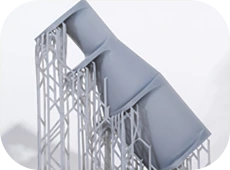
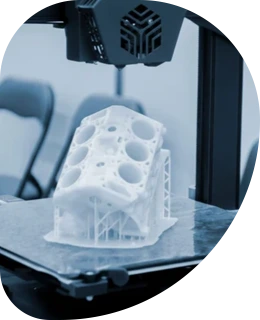
SLA enables the production of larger, lightweight prototype parts, using internal lattice structures for support.

Easy to Post-Process
Parts produced by HLH’s SLA printing service are easy to finish by sanding, painting and/or clear coating.
Applications of SLA
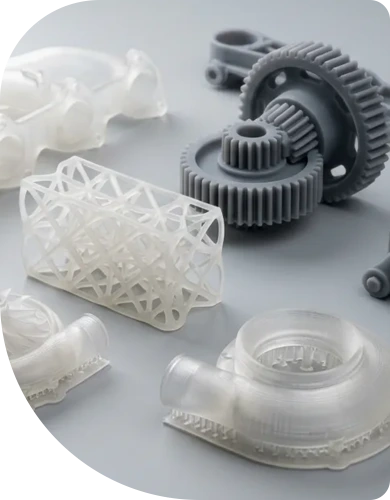
Stereolithography produces parts with accurate, detailed features and a high-quality surface finish that is perfect for creating visual prototypes. SLA prototypes are popular within industries that rely heavily on new product innovation, including but not limited to:
SLA Material Options
High Temp Resin
We provide high-temperature resin options tailored for use in demanding environments like ducting, molding, and prototyping, particularly within the automotive and aerospace sectors.
Rigid Resin
Rigid SLA resins deliver excellent stiffness and a smooth, high-quality finish. Known for their strength and resistance to deformation, these resins are ideal for functional applications, such as creating jigs and fixtures.
Nylon-Like Resin
Taurus is a nylon-like SLA material that closely mimics the look and feel of injection-molded parts. With strong mechanical properties, it is well-suited for outdoor applications, casings, and certain functional prototypes.
Transparent Resin
At HLH, we specialize in 3D printing aesthetically pleasing transparent parts. Transparent SLA resins are typically stiff, and due to the structural support needed during printing, design freedom may be somewhat limited.
Generic Resin
C-UV 9400 is an ABS-like SLA resin known for its precision and durability. It’s ideal for applications such as master patterns, concept models, general parts, and prototypes across industries like automotive, medical, and consumer electronics.
High Toughness Resin
As the name implies, high toughness resins are highly durable and resistant to breaking. These resins are extremely firm, capable of withstanding cyclic loads, and designed to endure high stress or strain for short durations. They are suitable for certain functional applications.
SLA 3D printing post-processing
Unfinished
Dots or standing “nibs” may remain visible on the bottom of the part due to support structure remnants. This finish is ideal when fast lead times or cost efficiency is a priority.
Natural
Supported surfaces are sanded to remove the support nibs, providing a smoother finish.
Standard
Dots or standing “nibs” may remain visible on the bottom of the part due to support structure remnants. This finish is ideal when fast lead times or cost efficiency is a priority.
Custom
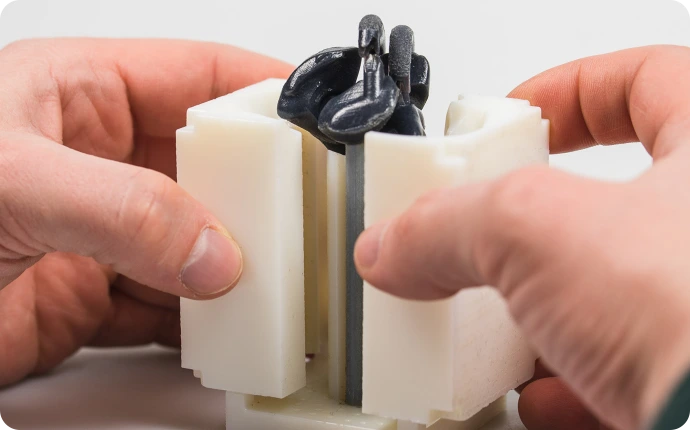
Options for custom finishes include soft-touch paint, clear part finishing, painting, masking, color matching, decals/graphics, and various texture finishes.
Request A Quote
Ready for Pricing? Let’s Get Started.
Please place file(s) for transfer in the same folder and ZIP or RAR before attaching.
Video display

What it’s like to work with HLH – in our customers’ words

"It is a pleasure to work with a company whose personnel are willing and able to think out of their box. With your commitment to staying on the cutting edge of technology, you supply tooling to us that is right on time and works first shot."


"Not many other manufacturing facilities would prioritize a job with a volume this low. They treated us as if we were a long-time customer bringing in high-volume business."

“HLH has been a strong partner on our EV programs. They helped us optimize a few key mponents for weight and manufacturability, and they consistently hit the tolerances we need. Their fast turnaround times have kept our development cycles moving, which is critical in EV work.”
Recent Articles/Blog
3D Printing vs, CNC vs. Vacuum Casting
This article compares and contrasts three common manufacturing methods: 3D printing, CNC machining, and vacuum casting.
How Much Does 3D Printing Cost?
Learn about 3D printing costs, including in-house vs. outsourcing options, with a free cost calculator and saving tips.
CNC Machining Price Guide: Breakdown & Price Comparison
Break down CNC machining prices, learn cost-saving strategies, and compare several major CNC service providers.