MJF 3D Printing Service

Fast-turnaround prototyping
Industrial-grade 3D printing
Precision parts on demand



What is Multi Jet Fusion?
Production Capacity

380mm*284mm*380mm

2-3 business days

±0.2/100mm

25-100 um
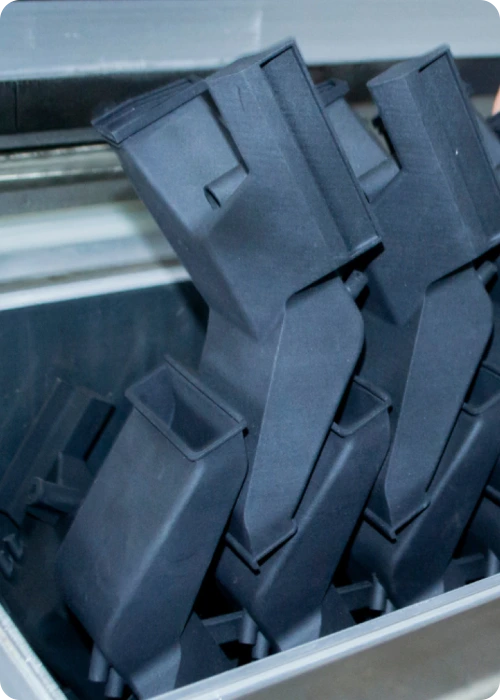
MJF 3D Printing Overview
MJF (Multi Jet Fusion) 3D printing is an advanced additive manufacturing process, It
creates parts by selectively fusing powdered material—typically nylon or similar
polymers—using chemical agents and heat.
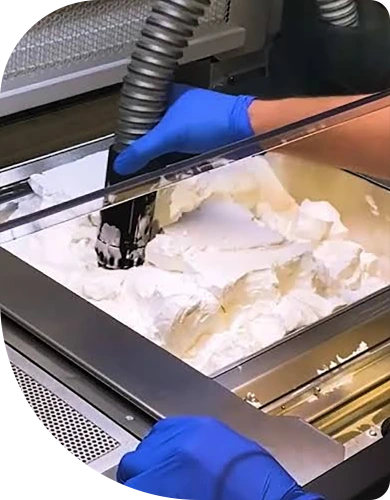
The process begins with a thin, even layer of powder spread across the build platform.
Specialized printheads then deposit a fusing agent on areas meant to solidify, plus a
detailing agent along edges to sharpen boundaries and boost precision. Next, a powerful
infrared heating element passes over the layer: treated areas fuse into solid material,
while untreated powder stays loose. This layering cycle repeats—new powder spread,
selectively fused—until the part is fully built.
Advantages of HLH MJF Printing

Complex Geometries
HLH’s MJF printing service can be used to print highly detailed and dimensionally accurate parts. That makes it well-suited for producing functional prototypes and end-use parts with unique shapes.

Excellent Surface Finish
Because MJF uses a thin layer structure, it offers one of the smoothest surface finishes of any 3D printing technology.

Produce a Large Volume of Parts Quickly
Multiple parts can be produced at the same time in a single build.

Excellent Mechanical Properties
Parts produced using MJF have excellent isotropic mechanical properties.That’s because it doesn’t require support structures.
Applications Showcase the Versatility of MJF
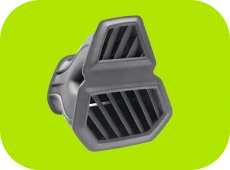
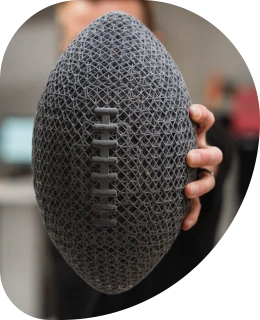

Medical
MJF is frequently used to build customized dental implants and prosthetics that must be customized to individual patient needs.

Aerospace
The toughness and durability of MJF parts make them an easy selection for applications like drone frames and aircraft components.

Manufacturing
The incredible toughness of MJF parts make them well-suited to manufacturing jigs, fixtures and tooling. It’s also used to produce end-of-arm tooling for robots.

Automotive
MJF is used to produce highly durable components like engine housings and door hinges, both for prototype and production vehicles.
MJF 3D Printing Materials
PA 12
PA 12 is a high-tensile strength nylon known for its durability and smooth surface finish. The final parts are dyed black and offer slightly more isotropic mechanical properties compared to SLS materials. With a smaller minimum feature resolution of 0.02 in (versus 0.03 in for SLS), PA 12 Black is ideal for detailed designs and is the preferred choice for living hinges due to its flexibility and strength.
PA 11
PA 11 is a bio-based nylon made from castor oil—so it’s renewable, and it brings tough, flexible performance. It handles cold really well too: even at -40°C (-40°F), it still resists impact. It doesn’t absorb much water, so parts stay dimensionally stable in humid environments, and it stands up to oils and greases. With MJF, it delivers consistent strength across all axes, and it works with post-processing like dyeing or sanding—great for flexible parts like medical components or outdoor gear.
PP
PP (Polypropylene) is a lightweight, budget-friendly thermoplastic that pairs well with MJF. It resists chemicals, doesn’t absorb much moisture, and balances rigidity with a little give—so it works in all kinds of settings, from general industrial use to consumer goods. MJF’s powder bed process makes consistent parts, and you can trim or polish them for a nicer finish. It’s ideal for non-load-bearing parts—think housings, containers, or light industrial fittings.
MJF 3D printing post-processing
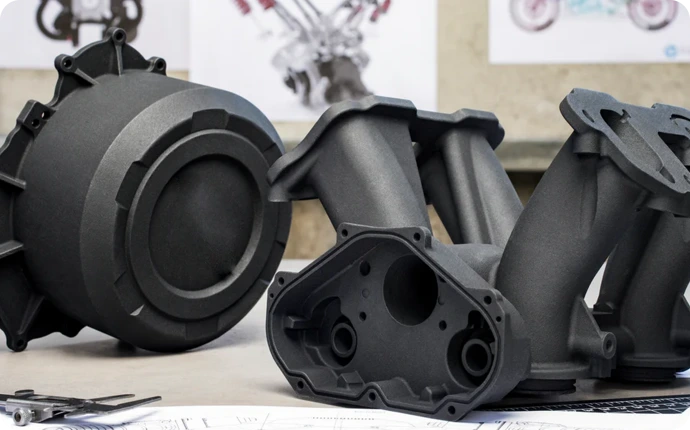
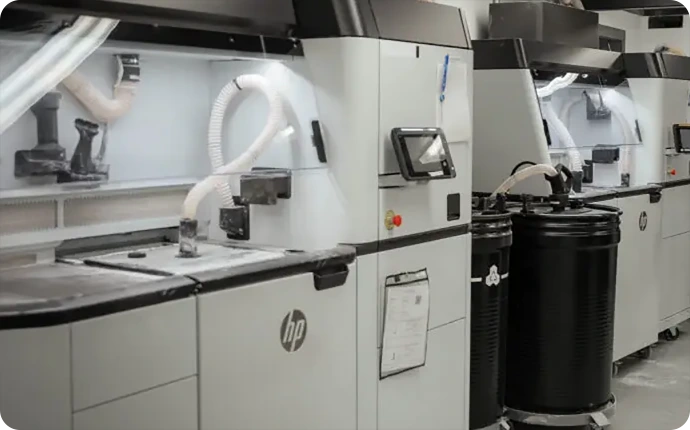
Sanding (Standard)
Bead blasting removes all excess powder, leaving a uniform texture
Vapor Smoothing
Reduces surface roughness from 250+ μin RA (as-printed) to 64 – 100 μin RA. Applicable for all MJF printed materials.
Dyeing
A main way to color MJF parts (usually black).
Custom Finishing
Includes secondary options such as priming, tapping, and inserts for enhanced part functionality.
Request A Quote
Ready for Pricing? Let’s Get Started.
Please place file(s) for transfer in the same folder and ZIP or RAR before attaching.
Video display

What it’s like to work with HLH – in our customers’ words

"It is a pleasure to work with a company whose personnel are willing and able to think out of their box. With your commitment to staying on the cutting edge of technology, you supply tooling to us that is right on time and works first shot."


"Not many other manufacturing facilities would prioritize a job with a volume this low. They treated us as if we were a long-time customer bringing in high-volume business."

“HLH has been a strong partner on our EV programs. They helped us optimize a few key mponents for weight and manufacturability, and they consistently hit the tolerances we need. Their fast turnaround times have kept our development cycles moving, which is critical in EV work.”
Recent Articles/Blog
3D Printing vs, CNC vs. Vacuum Casting
This article compares and contrasts three common manufacturing methods: 3D printing, CNC machining, and vacuum casting.
How Much Does 3D Printing Cost?
Learn about 3D printing costs, including in-house vs. outsourcing options, with a free cost calculator and saving tips.
CNC Machining Price Guide: Breakdown & Price Comparison
Break down CNC machining prices, learn cost-saving strategies, and compare several major CNC service providers.