MJF 3D Printing Service in China
High-Performance Multi Jet Fusion Parts for Prototyping and Production

Fast-turnaround prototyping
Industrial-grade 3D printing
Precision parts on demand



Why Choose HLH MODEL for MJF 3D Printing?
From startups developing new products to global OEMs seeking reliable manufacturing support, we help customers accelerate product development while reducing tooling costs and lead times.
- ✓ Fast turnaround in as little as 2–3 business days
- ✓ High-density nylon parts with excellent mechanical properties
- ✓ Superior dimensional accuracy and repeatability
- ✓ Ideal for prototypes and low-volume production
- ✓ Free DFM review and engineering consultation
- ✓ Factory-direct manufacturing in China
- ✓ Dedicated project managers and sales engineers
- ✓ Global shipping and responsive customer support
What Is Multi Jet Fusion (MJF) 3D Printing?
MJF Printing Capabilities
Our engineering team can help determine the optimal material and manufacturing strategy based on your performance requirements, budget, and production volume.

380mm*284mm*380mm

2-3 business days

±0.2/100mm

25-100 um
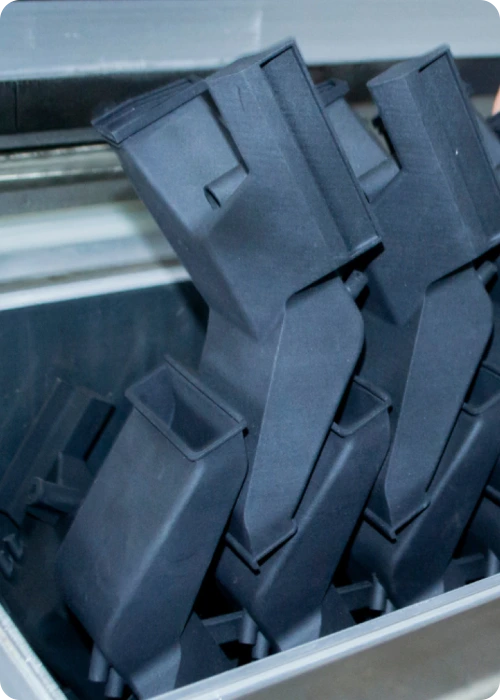
MJF 3D Printing Overview
Multi Jet Fusion (MJF) is an advanced powder-bed additive manufacturing technology that produces strong, detailed, and highly functional plastic parts.
The process works by depositing specialized fusing and detailing agents onto a thin layer of polymer powder. Infrared energy then selectively fuses the material, creating solid cross-sections of the part. This process repeats layer by layer until the entire component is completed.
Unlike traditional manufacturing methods, MJF requires no tooling and enables the production of complex geometries that are difficult or impossible to manufacture using machining or molding.
MJF is widely used for:
- Functional prototypes
- Engineering validation parts
- Production tooling
- End-use components
- Custom manufacturing aids
- Low-volume production
Benefits of MJF 3D Printing at HLH MODEL

Complex Geometries Without Limitations
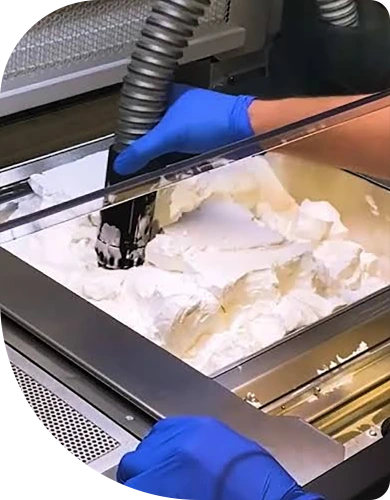
The powder surrounding each part acts as natural support during printing, allowing engineers to design intricate structures, internal channels, snap-fit features, and lightweight geometries.

Excellent Surface Quality
Compared to many additive manufacturing technologies, MJF produces smoother surfaces and more refined feature detail, reducing post-processing requirements and improving product appearance.

Produce a Large Volume of Parts Quickly
Multiple parts can be produced at the same time in a single build.

Excellent Mechanical Properties
Parts produced using MJF have excellent isotropic mechanical properties.That’s because it doesn’t require support structures.
Exceptional Part Accuracy
MJF technology produces highly detailed components with precise dimensions and consistent repeatability. It is ideal for applications requiring tight tolerances and reliable performance.
Strong and Durable Parts
MJF parts offer excellent mechanical properties, including high tensile strength, impact resistance, and dimensional stability. These characteristics make MJF suitable for both functional testing and end-use applications.
Fast Production for Multiple Parts
Because multiple components can be nested within a single build, MJF is highly efficient for producing batches of prototypes or production parts without additional tooling investment.
Cost-Effective Alternative to Tooling
For low-volume production and product development, MJF eliminates the need for expensive molds and significantly reduces time-to-market.
Applications of MJF 3D Printing
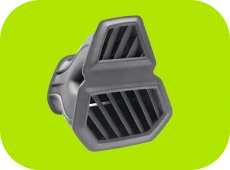
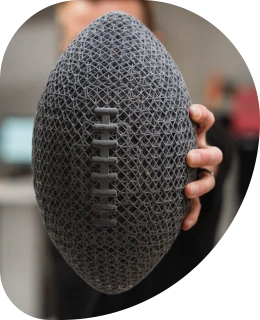

Medical Devices
MJF provides the accuracy and repeatability needed for medical product development and specialized device applications.
Examples include:
- ✓ Device housings
- ✓ Functional prototypes
- ✓ Ergonomic testing models
- ✓ Customized equipment components

Aerospace Applications
MJF supports the production of lightweight, high-performance parts used in aerospace development programs.
Common applications include:
- ✓ Ducting systems
- ✓ Brackets
- ✓ Structural prototypes
- ✓ Lightweight assemblies

Product Development and Rapid Prototyping
MJF enables engineers to quickly validate product designs, evaluate assemblies, and perform functional testing before investing in production tooling.
Typical applications include:
- ✓ Product prototypes
- ✓ Design verification models
- ✓ Engineering validation parts
- ✓ Functional assemblies

Automotive and EV Components
Automotive manufacturers use MJF to create lightweight and durable components for development, testing, and production support.
Examples include:
- ✓ Interior components
- ✓ Mounting brackets
- ✓ Airflow systems
- ✓ Custom housings
- ✓ Functional prototypes
MJF 3D Printing Material Options
PA12 (Nylon 12)
PA12 is the most widely used MJF material due to its excellent balance of strength, toughness, and dimensional stability. It is Ideal for; Functional prototypes, Mechanical components, Snap-fit designs, and Production parts. Benefits of PA12 are; High strength, Excellent surface finish, Good chemical resistance, and Reliable dimensional accuracy.
PA 11
PA11 is a bio-based nylon material that offers outstanding flexibility, impact resistance, and environmental durability. It is Ideal for; Flexible components, Medical applications, Outdoor products, and Wear-resistant parts. Benefits of PA11 are; Excellent toughness, Low moisture absorption, Strong impact resistance, and Renewable material source.
Polypropylene (PP)
PP is a lightweight and cost-effective material suitable for applications requiring chemical resistance and low weight. It is Ideal for; Housings, Containers, Consumer products, and Industrial components. Benefits of PP are; Lightweight, Chemical resistant, Moisture resistant, and Cost efficient.
MJF 3D Printing Post-Processing Options
To improve appearance and performance, HLH MODEL offers a variety of finishing options for MJF printed parts. Our engineering team can recommend the most suitable finishing process based on your project requirements.
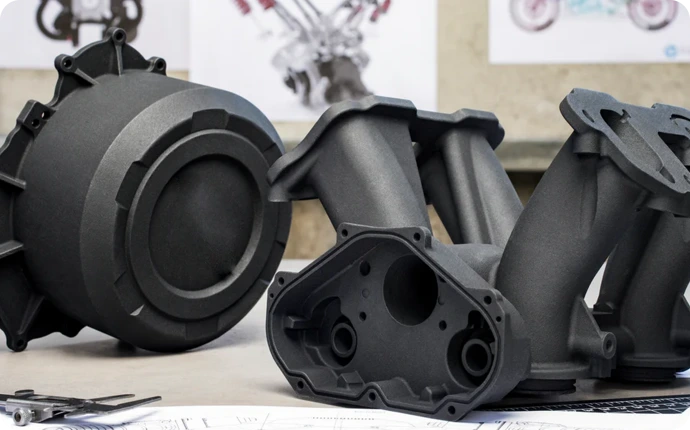
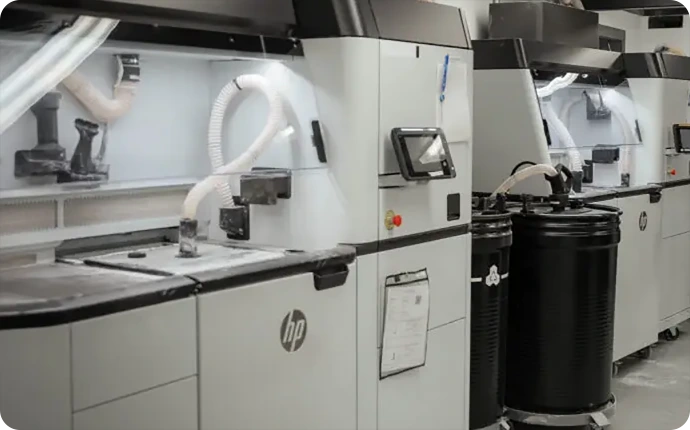
Bead Blasting
Standard post-processing that removes excess powder and creates a clean, uniform surface texture.
Vapor Smoothing
Enhances surface finish and reduces roughness for applications requiring improved aesthetics or easier cleaning.
Dyeing
Black dyeing is commonly used to improve visual appearance and create a professional production-like finish.
Custom Finishing
Additional finishing services include: Thread tapping, Heat-set inserts, Assembly, Custom finishing, and Surface preparation.
Why Global Companies Choose HLH MODEL For MJF 3D Printing?
Factory-Direct Manufacturing
Work directly with our engineering and production teams without intermediaries, ensuring better communication, faster decisions, and competitive pricing.
Engineering Support Before Manufacturing
Every project receives engineering review and free DFM analysis to help improve manufacturability and reduce overall production costs.
- Improve manufacturability
- Reduce unnecessary costs
- Select suitable materials
- Avoid production problems
Prototype-to-Production Partner
Beyond MJF 3D printing, HLH MODEL provides a comprehensive suite of engineering services:
Global Customer Service
Our English-speaking sales engineers and project managers support customers across North America, Europe, Oceania, and the Middle East.
Industries We Serve
Providing custom solutions for high-demand sectors:
Request a Quote for MJF 3D Printing
Looking for a trusted MJF 3D printing company in China? HLH MODEL combines advanced additive manufacturing technology, engineering expertise, and factory-direct production to deliver high-quality parts quickly and cost-effectively.
Whether you need a prototype, bridge production run, or end-use component, our team is ready to support your project.
Get Started Today:
- ✓ Upload your CAD file
- ✓ Receive free DFM feedback
- ✓ Get a quotation within 24 hours
- ✓ Start manufacturing with confidence
Request A Quote
Ready for Pricing? Let’s Get Started.
Please place file(s) for transfer in the same folder and ZIP or RAR before attaching.
Video display

See How We Help Innovators Meet Tight Production Deadlines

"Working with a team that consistently thinks outside the box is a true pleasure. Thanks to their commitment to cutting-edge technology, the tooling they deliver is always on time and performs flawlessly on the very first run."


"While most manufacturing facilities overlook low-volume projects, they treated our small order with the utmost priority. Their team delivered the same level of care and respect usually reserved for long-time, high-volume clients."

“HLH has been a strong partner on our EV programs. They helped us optimize a few key mponents for weight and manufacturability, and they consistently hit the tolerances we need. Their fast turnaround times have kept our development cycles moving, which is critical in EV work.”
Recent Articles/Blog
3D Printing vs, CNC vs. Vacuum Casting
This article compares and contrasts three common manufacturing methods: 3D printing, CNC machining, and vacuum casting.
How Much Does 3D Printing Cost?
Learn about 3D printing costs, including in-house vs. outsourcing options, with a free cost calculator and saving tips.
CNC Machining Price Guide
Break down CNC machining prices, learn cost-saving strategies, and compare several major CNC service providers.