SLS 3D Printing Service in China
Industrial-Grade Selective Laser Sintering for Functional Prototypes and Production Parts

Fast-turnaround prototyping
Industrial-grade 3D printing
Precision parts on demand



Why Choose HLH MODEL for SLS 3D Printing?
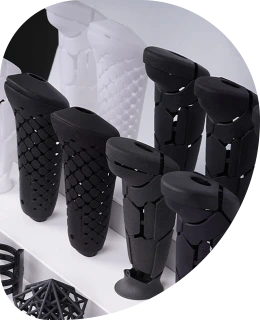

Fast Turnaround
Fast turnaround in as little as 1–3 business days

Free DFM & NO MOQ
Free DFM review before production

Reliable – Direct Factory
Factory-direct manufacturing with no middlemen
Dedicated Project Managers
Dedicated project managers and engineering assistance
Prototype to Production
Prototype to production manufacturing support
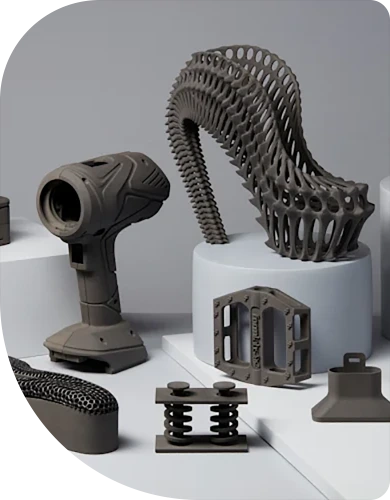
Complex Geometries
Complex geometries without support structures

High-Quality Materials
Functional nylon and TPU materials
Professional SLS 3D Printing Services – China
Production Specifications
At HLH MODEL, we utilize industrial SLS systems to produce high-performance prototypes, engineering validation models, and end-use components for customers worldwide.

345mm*345mm*420mm

Fast turnaround in as little as 1–3 business days

±0.2-0.3mm/100mm

25-100 um
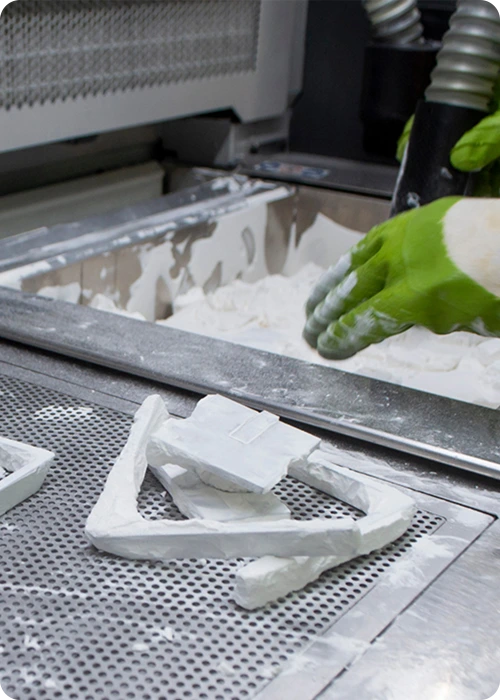
SLS 3D Printing Overview
Selective Laser Sintering (SLS) is one of the most widely used industrial additive
manufacturing technologies for producing strong, accurate, and functional plastic parts.
The process uses a high-powered laser to fuse powdered thermoplastic materials layer by
layer, creating components with excellent mechanical properties and outstanding design
freedom.
Unlike many other additive manufacturing methods, SLS does not require support structures.
The surrounding powder naturally supports the part during printing, enabling engineers to
create complex internal channels, lightweight structures, snap-fit assemblies, and
intricate geometries that would be difficult or impossible to manufacture using
conventional methods.
Whether you need a single prototype or a batch of production-ready components, our
engineering team will help select the optimal material and manufacturing approach for your
application.
Benefits of SLS 3D Printing at HLH MODEL

Design Freedom for Complex Parts
SLS technology enables the production of highly detailed components with intricate features, internal cavities, lattice structures, and organic geometries without tooling limitations. This makes it ideal for advanced product development and engineering applications.

Cost-Effective Low-Volume Manufacturing
Multiple parts can be nested and produced simultaneously within a single build chamber, reducing manufacturing costs and improving efficiency for prototype and bridge production programs.

No Support Structures Required
Since unsintered powder supports the part throughout the build process, there is no need for support material. This results in greater design flexibility, improved surface accessibility, and reduced post-processing requirements.

Strong Functional Performance
SLS parts offer excellent mechanical strength, wear resistance, and dimensional stability. Many applications use SLS components for functional testing and end-use production parts.

Faster Product Development
With tooling eliminated, design iterations can be manufactured quickly, helping engineers validate concepts, test assemblies, and accelerate time-to-market.

Wide Range of Finishing Options
SLS parts can be dyed, painted, polished, or surface treated to achieve improved aesthetics, identification, and functional performance.
Applications of SLS 3D Printing
SLS is trusted across multiple industries because of its ability to produce durable,
lightweight, and highly functional components.
SLS is particularly valuable when traditional manufacturing methods are too expensive, too slow,
or unable to achieve the required geometry.
3D Printed Medical Devices
Create custom-fit medical products, surgical planning models, orthotic devices, and engineering prototypes requiring precision and repeatability.
Aerospace 3D Printed Parts
Manufacture lightweight brackets, housings, ducts, and engineering prototypes designed to reduce weight while maintaining structural integrity.
Consumer Products
Validate product designs and manufacture complex consumer components such as wearables, sporting goods, eyewear, and electronic enclosures before full-scale production.
SLS 3D Printing for Automotive
Used for prototyping and creating functional parts, including snap-fit and living hinge components.
SLS 3D Printing Material Options
Selecting the right material is critical to achieving the required performance, durability, and cost objectives. HLH MODEL offers a range of engineering-grade SLS materials to support diverse applications.
TPU (Thermoplastic Polyurethane)
TPU combines flexibility, elasticity, and toughness, making it ideal for soft-touch and
impact-resistant applications.
Applications include:
- Seals and gaskets
- Flexible enclosures
- Wearable products
- Medical components
- Automotive interior parts
PA12 Glass-Filled (PA12+GF)
Glass-filled nylon delivers higher stiffness, improved wear resistance, and greater
thermal performance compared to standard PA12.
Applications include:
- Structural components
- Automotive parts
- Aerospace applications
- High-load engineering assemblies
- Industrial machinery components
PA12 (Nylon 12)
PA12 is one of the most widely used SLS materials due to its excellent balance of
strength, durability, chemical resistance, and dimensional stability.
Applications include:
- Functional prototypes
- Engineering housings
- Mechanical assemblies
- Industrial components
- Consumer products
SLS Finishing and Post-Processing Options
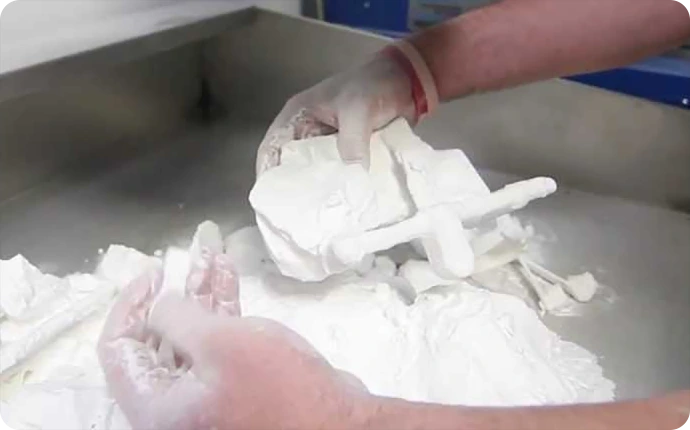
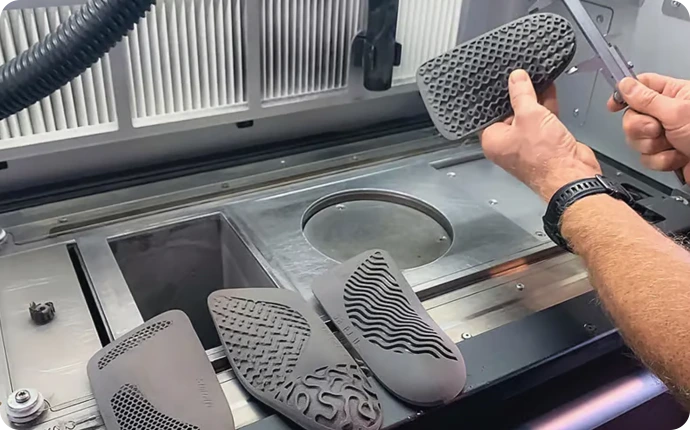
To improve appearance, functionality, and product readiness, HLH Model offers a variety of post-processing services for SLS parts.
Dyeing
Achieve uniform coloration across the entire component, including internal and hard-to-reach surfaces.
Painting
Improve visual appearance, branding, and product presentation with custom paint finishes.
Polishing
Reduce surface roughness and enhance aesthetics while improving cleanliness and handling characteristics.
Spray Painting
Apply protective or decorative coatings to improve appearance, durability, and environmental resistance.
Additional finishing services may be available depending on project requirements. Contact our engineering team for customized solutions.
Get a Fast SLS 3D Printing Quote
Looking for a reliable SLS 3D printing company in China?
HLH Model combines advanced manufacturing equipment, experienced engineers, and
factory-direct production to deliver high-quality SLS parts quickly and cost-effectively.
Whether you need a functional prototype, design validation model, or low-volume
production run, our team is ready to support your project.
What You Receive
- Free DFM review
- Material selection support
- Engineering consultation
- Competitive factory-direct pricing
- Quote within 24 hours
- Global shipping
Request A Quote
Ready for Pricing? Let’s Get Started.
Please place file(s) for transfer in the same folder and ZIP or RAR before attaching.
Video display

See How We Help Innovators Meet Tight Production Deadlines

"Working with a team that consistently thinks outside the box is a true pleasure. Thanks to their commitment to cutting-edge technology, the tooling they deliver is always on time and performs flawlessly on the very first run."


"While most manufacturing facilities overlook low-volume projects, they treated our small order with the utmost priority. Their team delivered the same level of care and respect usually reserved for long-time, high-volume clients."

“HLH has been a strong partner on our EV programs. They helped us optimize a few key mponents for weight and manufacturability, and they consistently hit the tolerances we need. Their fast turnaround times have kept our development cycles moving, which is critical in EV work.”
Recent Articles/Blog
3D Printing vs, CNC vs. Vacuum Casting
This article compares and contrasts three common manufacturing methods: 3D printing, CNC machining, and vacuum casting.
How Much Does 3D Printing Cost?
Learn about 3D printing costs, including in-house vs. outsourcing options, with a free cost calculator and saving tips.
CNC Machining Price Guide
Break down CNC machining prices, learn cost-saving strategies, and compare several major CNC service providers.