Industrial SLA 3D Printing Service – China

Fast-turnaround Prototyping
Industrial-grade SLA 3D Printing
Precision 3D Printed Parts On Demand



High-Precision SLA 3D Printing Services
Production Capacity

1700mm*800mm*600mm

1-3 business days

±0.1-0.3mm/100mm

25-100 um
Industrial SLA 3D Printing Technology Overview
Stereolithography (SLA) is an advanced additive manufacturing method that utilizes a
computer-controlled UV laser to selectively cure and solidify liquid photopolymer resin
layer by layer. This precise layer-upon-layer fabrication technique allows product
designers and engineers to transform complex 3D CAD files into highly accurate physical
parts with complex micro-features and ultra-smooth surface finishes.
By tightly controlling the laser path, SLA manufacturing eliminates the visible layer
lines common in other 3D printing methods, making it the premier choice for parts
requiring fine cosmetic detail and strict dimensional tolerances. Industries such as
aerospace, automotive, EV, and medical technology rely on SLA for high-fidelity rapid
prototyping, fit-and-form testing, master patterns, and low-volume production runs. This
versatile manufacturing process delivers unmatched speed, cosmetic clarity, and geometric
freedom for challenging engineering designs.
Advantages of HLH MODEL’s SLA Printing

Premium-Quality Surface Finishes
SLA additive manufacturing delivers exceptional dimensional fidelity and smooth as-printed surfaces, making these prototypes ideal for rigorous form, fit, and cosmetic testing before production tooling.

Optically Clear Components
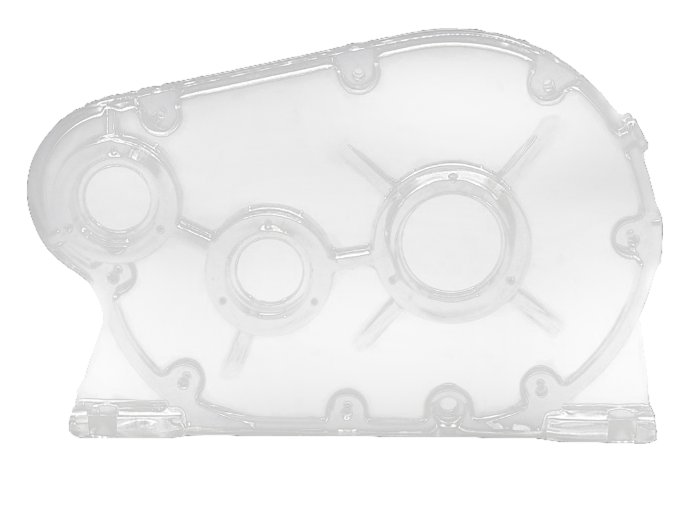
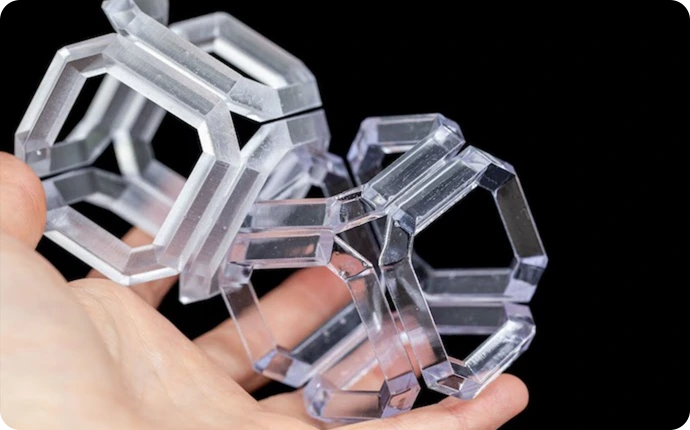
HLH MODEL utilizes premium transparent resins combined with advanced manual post-processing to deliver glass-like clarity, perfect for fluid-flow visualization, light pipes, and translucent enclosures.

High-Resolution Complex Geometries
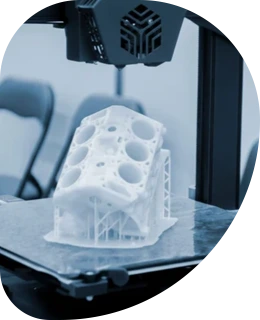
With micronic resolution capabilities, stereolithography easily executes ultra-thin walls, sharp internal corners, micro-holes, and intricate geometric features that traditional CNC machining cannot replicate.

Strict Dimensional Tolerances
Our industrial SLA technology achieves some of the tightest tolerances in additive manufacturing (up to ±0.1mm per 100mm), ensuring exact alignment and predictable performance in complex mechanical assemblies.

Large-Scale Lightweighting
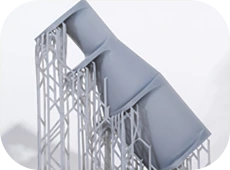
Leveraging a massive 1700mm build volume, we produce oversized, monolithic prototype components integrated with internal lattice structures to significantly reduce part weight while maintaining structural integrity.

End-Use Post-Processing Capabilities
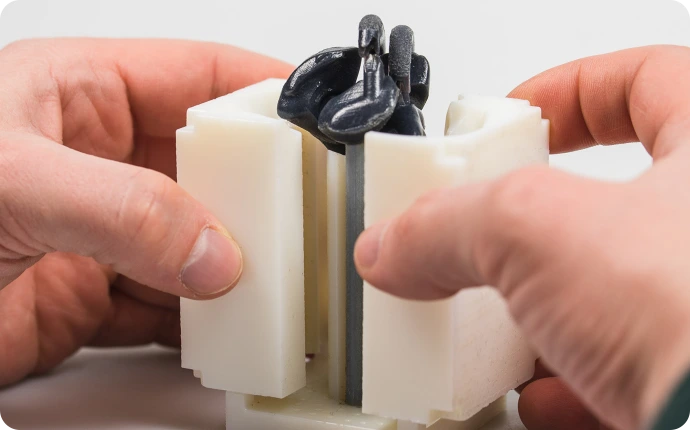
SLA photopolymer parts serve as the perfect canvas for secondary finishing, allowing our technicians to efficiently execute precision sanding, custom color-matched painting, masking, and protective clear coating.
Versatile Industrial Applications of Stereolithography
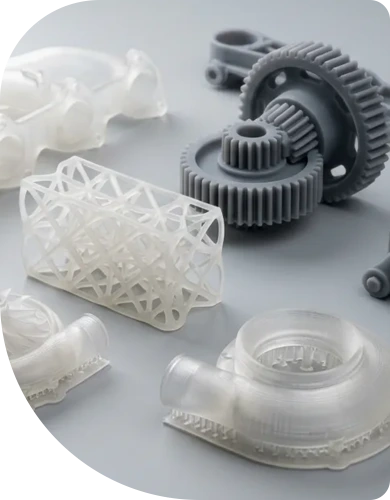
Industrial SLA 3D printing delivers the high dimensional fidelity, microscopic feature resolution, and pristine surface finishes required for advanced product development. HLH MODEL supports rapid product innovation across diverse, demanding sectors by transforming complex CAD files into high-performance parts.
Fabricate anatomically accurate visual aids, ergonomic surgical guides, and customized healthcare equipment housing with biocompatible resin options.
Produce lightweight aerodynamic components, complex under-the-hood ducting, and hyper-detailed dashboard assemblies for immediate fit-and-form testing.
Create high-fidelity enclosure prototypes with premium textures, precise snap-fits, and glass-like display windows to evaluate aesthetics before tooling.
Engineers deploy SLA to print complex internal fluid channels, wind-tunnel testing models, and lightweight structural brackets using high-stiffness resins.
Accelerate the R&D cycle by testing intricate mechanical assemblies, custom jigs, and specialized production fixtures in real-world environments.
Produce flawlessly smooth, dimensionally stable SLA models used directly as master patterns for vacuum casting, silicone molding, and investment casting.
SLA Material Options
High Temp Resin
High-temperature SLA resin, also known as thermal-resistant photopolymers, is formulated to withstand intense thermal stress and maintain structural integrity under load. This material is specifically engineered for demanding industrial applications, including aerodynamic engine ducting, rapid injection molding inserts, and high-performance automotive or aerospace R&D prototyping. Discover how our high-temperature resin can meet your specific project requirements.
Rigid Resin
Rigid SLA photopolymers are engineered for high structural modulus, delivering exceptional stiffness and a smooth, production-grade finish. These materials resist bending and deformation, making them ideal for functional manufacturing aids, jigs, and structural enclosures.
Nylon-Like Resin
Taurus is a robust, nylon-like SLA resin engineered to emulate the appearance, tactile feel, and mechanical performance of injection-molded thermoplastics. It is a high-performance material ideal for durable functional prototypes, industrial enclosures, and outdoor equipment casings due to its excellent impact resistance and elongation properties.
Transparent Resin
HLH specializes in 3D printing optically clear SLA resin parts suitable for applications like fluid dynamics visualization and clear product housings. While the material is stiff and requires support structures that may limit design freedom, DFM reviews help optimize part orientation for superior aesthetics and performance.
Generic Resin
C-UV 9400 is an engineering-grade, ABS-like SLA resin designed for high-precision, durability, and dimensional accuracy in producing master patterns, functional prototypes, and consumer electronic parts. It is widely used across the automotive and medical sectors for its stability and crisp detailing.
High Toughness Resin
High-toughness SLA resins are engineered with advanced impact resistance and elongation properties to prevent brittle fracturing under mechanical load. This durable, fatigue-resistant photopolymer withstands cyclic loading, high stress, and temporary high strain, making it ideal for functional snap-fits, living hinges, and ruggedized industrial field-testing prototypes.
SLA 3D Printing Post-Processing: Step-by-Step Resin Finishing Guide
Unfinished (As-Printed)
What it is: Parts are extracted from the SLA printer, rinsed in an
automated isopropyl alcohol (IPA) bath to remove residual liquid photopolymer resin, and
fully UV-cured.
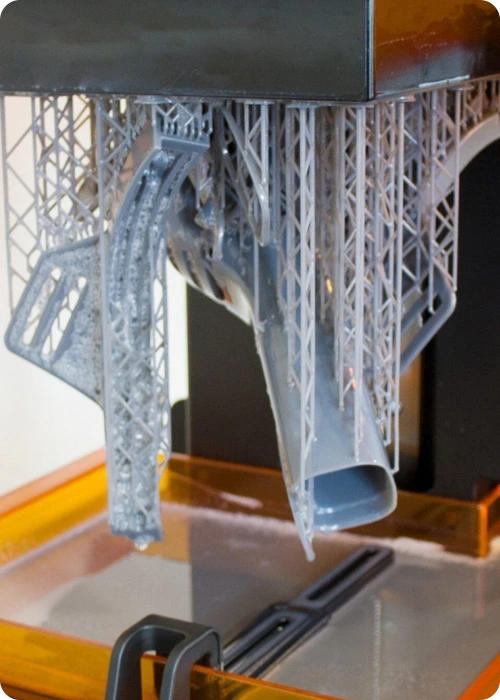
Surface characteristics: Support structures
remain completely intact. The surface displays minor bumps and witness marks where the
lattice anchors touched the part.
Best use case: Internal
mechanical components, fit-check iterations, or projects where the client prefers to
perform internal post-processing and hand-finishing.
Natural (Support Removal Only)
What it is: Technicians carefully snip away all support structures and
lightly sand the remaining anchor nubs flush with the part’s surface geometry.
Surface characteristics: The part retains its raw, uniform matte
finish. While support marks are leveled, the natural layer lines (typically 25–100
microns) remain visible upon close inspection.
Best use case:
Functional prototypes, low-cost engineering verification builds, and master patterns
used for secondary vacuum casting or silicone molding.
Standard (Sanded & Uniform Finish)
What it is: The part undergoes a complete support removal followed by a
meticulous, progressive hand-sanding process across all accessible surfaces.
Surface characteristics: A smooth, uniform matte or satin finish
with completely erased layer lines. For clear resins, this step includes a preliminary
polish to eliminate translucency blockages.
Best use case:
Pre-production visual prototypes, form-and-fit testing, and high-fidelity assembly
modeling for stakeholder reviews.
Custom (Premium Painting & Polish)
What it is: The highest tier of industrial finishing. Parts are sanded,
primed, and treated with secondary operations such as custom color-matched painting,
texturing, or clear coating.
Surface characteristics: Flawless,
injection-mold quality aesthetics. Clear resins are polished to optical, glass-like
transparency, while solid resins can achieve high-gloss, soft-touch matte, or metallic
textures.
Best use case: Market research display models, consumer
electronics casings, trade show exhibitions, and end-use marketing prototypes.
Request A Quote
Ready for Pricing? Let’s Get Started.
Please place file(s) for transfer in the same folder and ZIP or RAR before attaching.
Video display

See How We Help Innovators Meet Tight Production Deadlines

"Working with a team that consistently thinks outside the box is a true pleasure. Thanks to their commitment to cutting-edge technology, the tooling they deliver is always on time and performs flawlessly on the very first run."


"While most manufacturing facilities overlook low-volume projects, they treated our small order with the utmost priority. Their team delivered the same level of care and respect usually reserved for long-time, high-volume clients."

“HLH has been a strong partner on our EV programs. They helped us optimize a few key mponents for weight and manufacturability, and they consistently hit the tolerances we need. Their fast turnaround times have kept our development cycles moving, which is critical in EV work.”
Recent Articles/Blog
3D Printing vs, CNC vs. Vacuum Casting
This article compares and contrasts three common manufacturing methods: 3D printing, CNC machining, and vacuum casting.
How Much Does 3D Printing Cost?
Learn about 3D printing costs, including in-house vs. outsourcing options, with a free cost calculator and saving tips.
CNC Machining Price Guide
Break down CNC machining prices, learn cost-saving strategies, and compare several major CNC service providers.